Choosing shampoo: what I want to point out to you
A long list of brands will not automatically help you. That's why I'll start here with what a shampoo should do.
Start with a mild shampoo that is explicitly intended for dogs and suits your dog's skin. Being able to rinse well is particularly important with a corded coat. A dog shampoo without added perfume is a useful starting point; If your dog has sensitive skin, ask your veterinarian for guidance. Do not use human shampoo or baby shampoo as your regular washing routine. [2][3] There is no proven best brand for every Puli. Look at the purpose of use, the instructions for use and your dog's reaction, not just at words like natural, premium or for black coat. This guide compares product types; I am not describing my own comparative product test here.
Why I keep cords and brushes apart
Marley is my starting point for this story. When explaining her coat type, I make an important distinction.
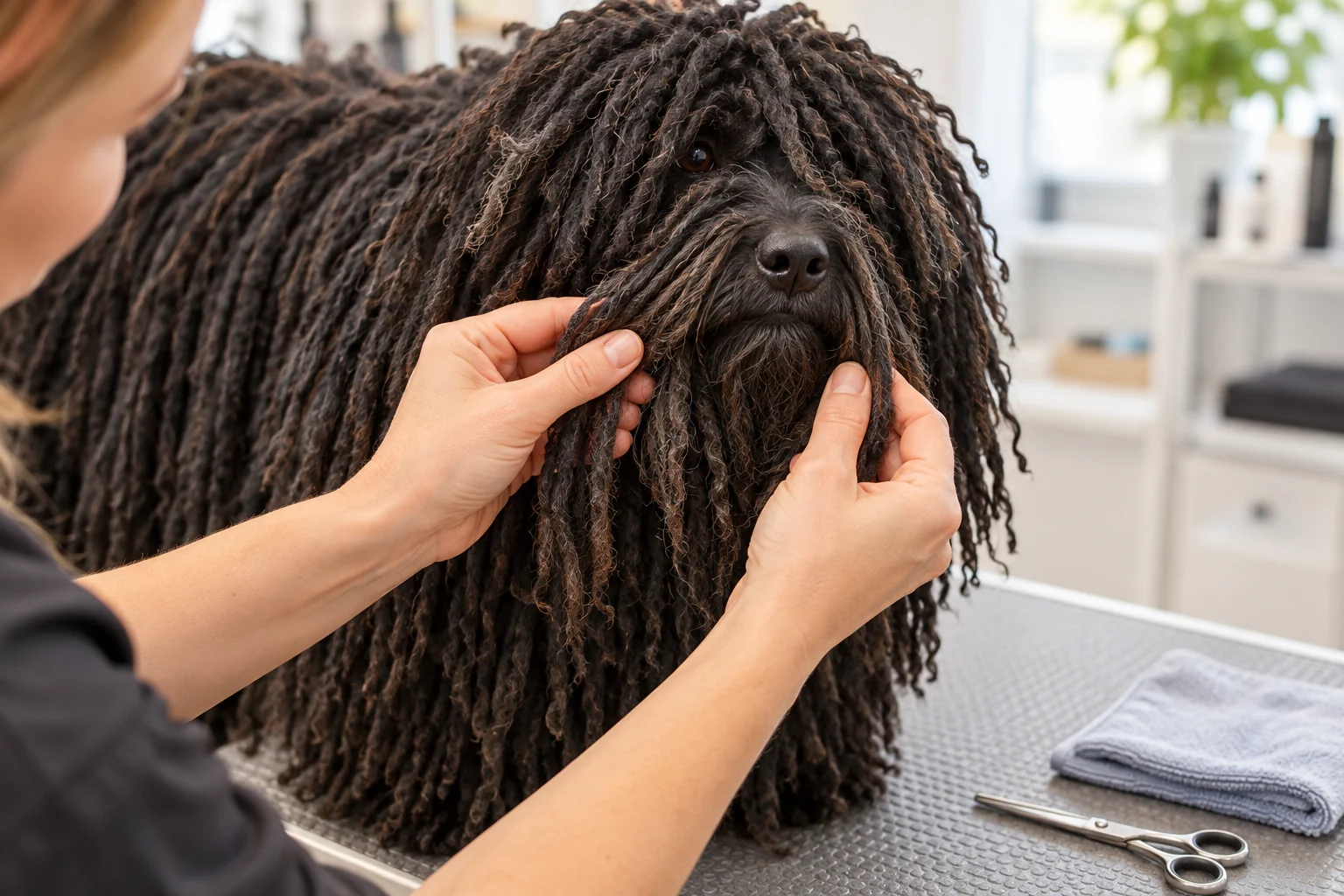
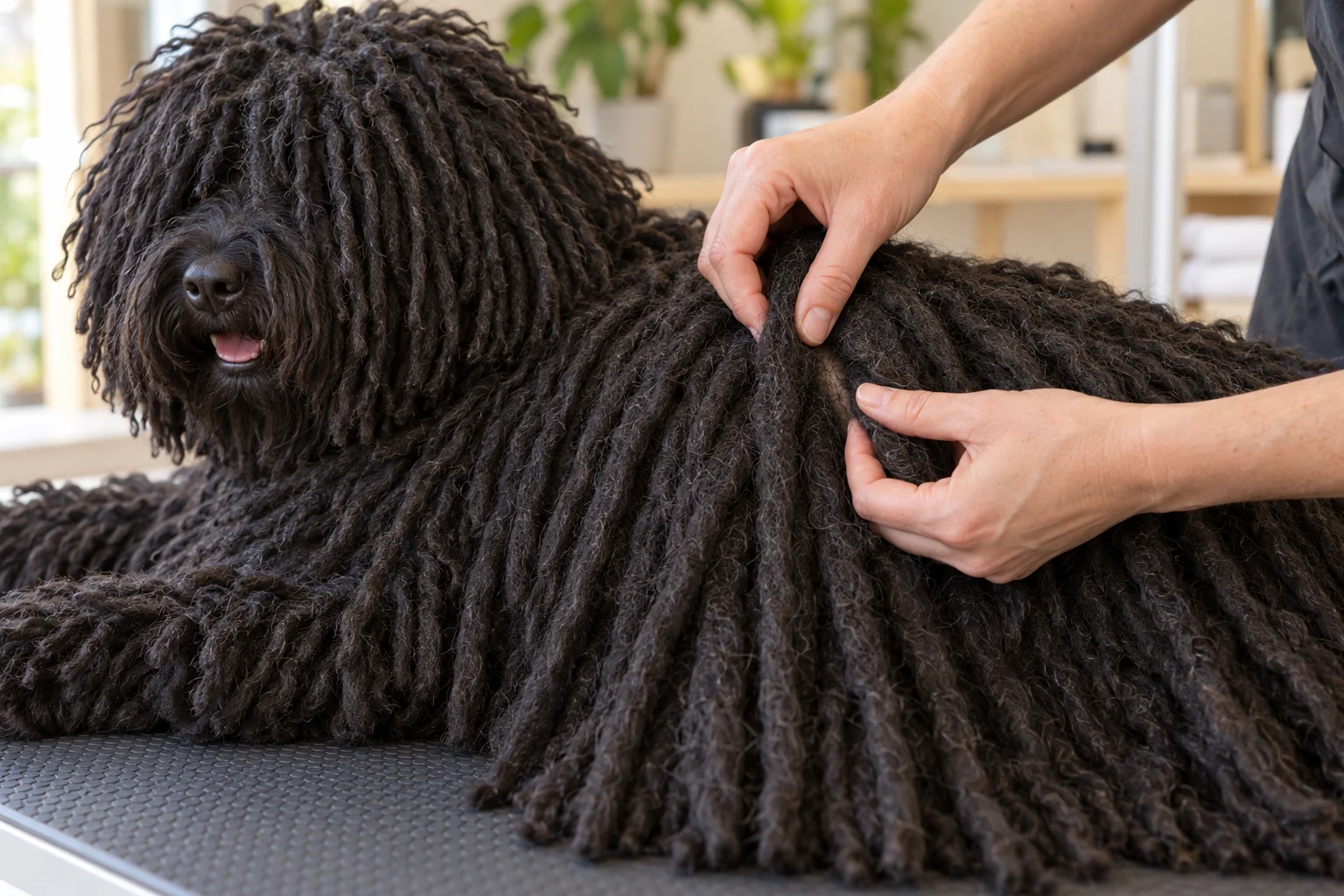
The Puli Club of America distinguishes between a brushed coat and a coat maintained in cords. They require a different routine. With cords, you guide the separation so that they do not become felted into large sheets. [1] So do not take the general advice to brush a dog before washing it literally for a Puli with cords. Have an experienced Puli groomer show you how to check the skin and gently keep joining cords separate. Do not pull on tightly matted areas or try to remove them blindly with scissors. Moreover, a puppy coat is not yet an adult corded coat.
My starting point: keep care products organized
I want to help you keep track of all the bottles and care supplies.
A simple selection for at home: one suitable dog shampoo, enough clean towels, a soft wash cloth, a non-slip mat and a shower head with an adjustable jet. A measuring cup or mixing bottle is useful if the label prescribes dilution. Keep the original packaging with the instructions. A conditioner or detangling spray is not an automatic additional purchase: general advice for a coat intended to be combed through does not automatically apply to cords. Discuss the desired coat result with a Puli groomer. The LICG emphasizes that materials differ per coat type. [2] You can choose medicated shampoo and products against parasites in consultation with your vet if there is a reason for this. [3]
Washing: work slowly, without rubbing hard
In my explanation, I prefer to take you slowly through the wash rather than promising a quick trick.
Before wetting, read whether your shampoo needs to be diluted and what ratio is prescribed. Do not use a fixed internet ratio for all bottles. Wet the coat thoroughly with a gentle stream of lukewarm water. Keep shampoo and shower water out of eyes, nose, mouth and ear canals. [4] Work slowly in small sections and gently squeeze the soapy water through the cords rather than scrubbing the coat harshly; the Hungarian Puli Association warns against rubbing cords that are still forming. [6] Use a damp cloth for the face. Arrange help in advance if your dog is restless or you cannot handle the heavy wet coat comfortably.
Why I pay so much attention to rinsing and drying
With a Puli I don't want the story to end as soon as the water goes out.
Rinse out all shampoo carefully, even on the skin and in thicker cords. The British Puli club particularly stresses this. [5] Then gently squeeze water from the coat and press towels against the cords instead of rubbing harshly. The adult corded coat needs a lot of time to get wet and dry. [1] Only plan a bath if you can supervise the complete drying process. Have a Puli groomer demonstrate a safe drying method; avoid hot air and do not leave your dog unattended under a dryer. Also check the cord base and thicker parts: feeling dry on the outside does not say everything about the inside.
How often wash? I'd rather not give you a fixed weekly schedule
I think a fixed washing calendar for every Puli is too strict. That's why I look at the dog's needs here.
Wash according to soiling and needs, not because every dog should follow the same weekly schedule. The American Puli Association recommends washing when dirty and regularly checking the skin and coat. [1] If you have a dirty beard or soiled underside, rinsing locally may be sufficient; the British breed association also describes this maintenance between full baths. [5] Then dry cleaned parts thoroughly. Take recurring odour seriously instead of adding perfume every time. Frequent re-washing is a reason to discuss the cause and the care routine. A prescribed washing treatment for a skin problem follows the veterinarian's schedule. [3]
My Puli experience is not a routine for every breed
I tell from life with Marley. For the other Hungarian breeds I use the information about their own coat type.
For every dog, a good choice starts with skin, coat type and the purpose of washing. Materials and brushing are tailored to the coat. [2][4] Therefore, do not use the cord technique on the curls of a Pumi, the wavy coat of a Mudi or the short coat of a Vizsla or Magyar Agár. The Komondor also has cords, but size, coat density and drying work require guidance suited to that breed. With a Wirehaired Vizsla, you will discuss washing along with the wirehaired coat routine. The general principles remain useful: a suitable dog product, careful rinsing and an approach that your dog can handle.
When my story gives way to vet advice
I cannot diagnose a skin problem. These are the signals that require expert help.
Persistent scratching, painful skin, bald spots or recurring strong odor cannot be solved by choosing a stronger scented shampoo. Contact the vet. Moisture that remains under felted areas can contribute to skin problems; an incipient wet, inflamed spot can be hidden under a thick coat. Cornell describes this connection with hotspots. [7] Do not use a homemade mixture of disinfectants, essential oils or household cleaners. For a prescription shampoo, follow the veterinary instructions for dilution, application time and frequency; which may differ from a normal wash. [3]
This way you make it clear
- 01
Check skin and cords first. If you have pain, wounds or felting, have a vet or experienced Puli groomer take a look.
- 02
Have shampoo, instructions, non-slip mat, washcloth and clean towels ready. Plan sufficient time for drying.
- 03
Dilute only according to the label. Wet the coat and gently work the product through the cords without rubbing hard.
- 04
Rinse thoroughly until no shampoo remains on the skin.
- 05
Gently squeeze out excess water and dry the coat completely using the method taught. Check comfort and skin in between.
- 06
Note how the skin and coat react after washing. Discuss recurring complaints before trying another remedy.
You may be wondering…
What is the best shampoo for a Puli?
There is no universally best brand. Choose a mild dog shampoo that suits the skin and can be easily rinsed from cords. In case of complaints, ask your veterinarian which product is appropriate. [3][4]
Can I use baby shampoo?
For regular washes, use a product for dogs. Baby shampoo is made for people and is not a standard alternative. [2][3]
Does a black Puli need color shampoo?
A color claim does not make shampoo necessary or automatically suitable. Start with cleaning, skin compatibility and rinsability. We do not recommend color treatment here.
Should I always use conditioner?
No, don't automatically add a product just because a general long hair guide mentions it. Ask a Puli groomer whether conditioner suits the condition of the coat and the way you want to maintain its cords.
Can the same shampoo also be used for a Vizsla or Pumi?
This is possible if the product is suitable for both individual dogs. A suitable shampoo does not mean that you use the same brushing or drying method. [2][4]
How long does it take to dry a Puli?
This varies with length, density, amount of residual water and drying method. A mature corded coat dries slowly; don't plan a bath based on one fixed drying time. [1]
The sources for my story
- Puli Club of America · Care of the Puli ↗
- LICG · Coat care for dogs ↗
- VCA Animal Hospitals · Grooming and Coat Care for Your Dog ↗
- AKC · Finding the Right Shampoo for Your Dog ↗
- Hungarian Puli Club of Great Britain · Puli Coat Care ↗
- Hungária Puli Klub · Grooming and Care ↗
- Cornell University · Hot spots ↗
I write from my experience with Marley. The general care information above has been supplemented with these sources. The illustrations do not document a grooming procedure performed on Marley. If your dog has symptoms, seek advice specific to your dog.